Belvès
The Seven Bell Towers of Belvès
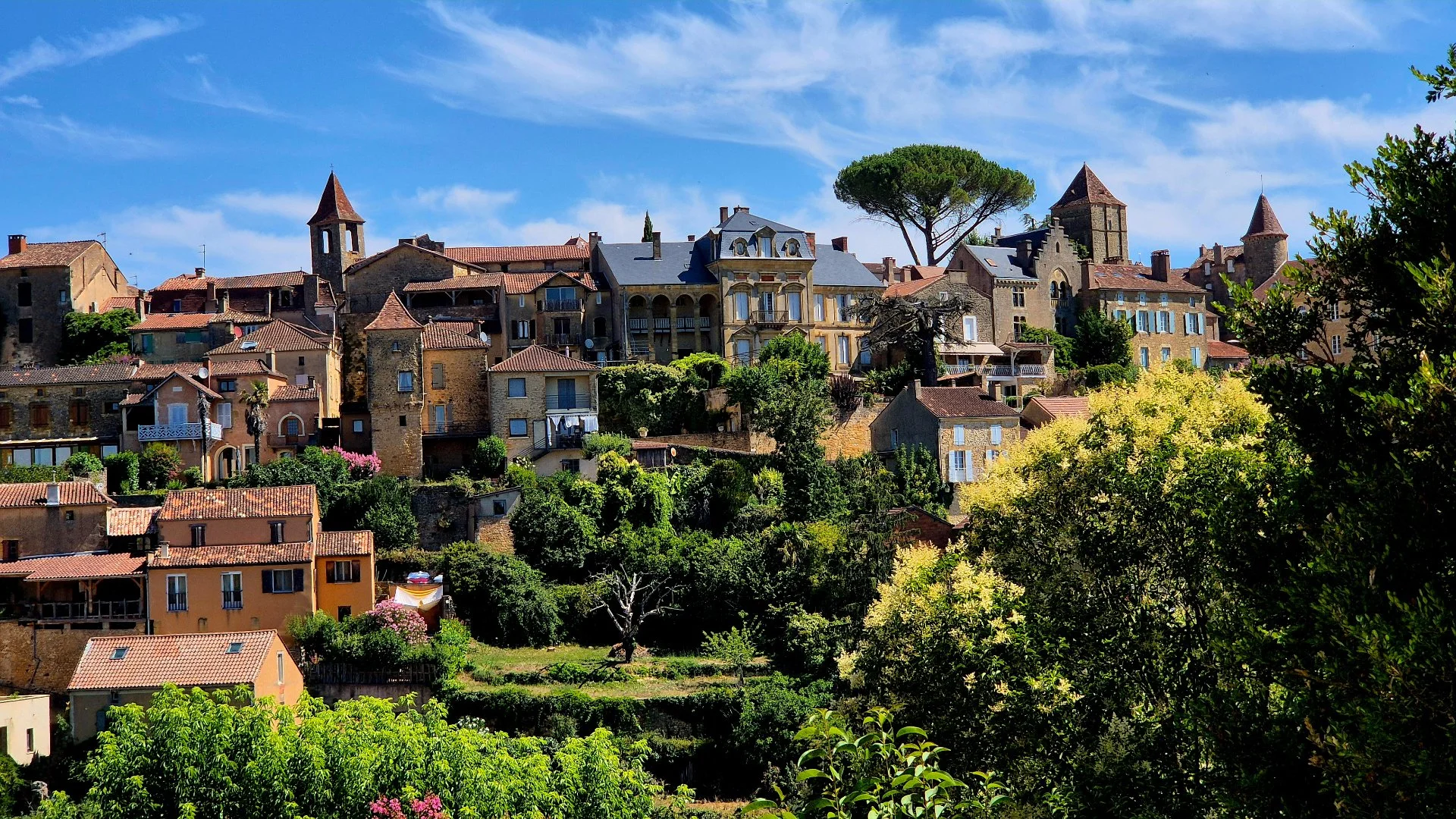
Belvès is often known as the “village of seven bell towers”
Where Are the Seven Bell Towers?
──────── ◆ ────────
Belvès is known across France as la cité médiévale aux sept clochers — the medieval town of seven bell towers.
It is the name that has come to define this hilltop town in the Périgord Noir.
Yet stand among the rooftops of Belvès today and try to count them.
One. Two. Three…
Where are the seven?
The answer lies in a skyline shaped by more than a thousand years of history.
Churches have been rebuilt. Chapels have disappeared. A convent church has vanished while its bell tower survived. A medieval defensive tower became a civic belfry.
Some clochers still rise above the town.
Others have been lost.
The seven bell towers of Belvès are not simply seven monuments waiting to be ticked off a list.
They are part of the story of Belvès itself.
──────── ◆ ────────
THE BELVÈS MYSTERY
──────── ◆ ────────
Can you count seven bell towers?
Look carefully as you explore the town.
Some still dominate the skyline.
At least one has disappeared entirely.
And the historic sources do not leave us a simple numbered list.
──────── ◆ ────────
Notre-Dame-de-l'Assomption - The Great Bell Tower of Montcuq
──────── ◆ ────────
At the western end of historic Belvès rises the town's most imposing bell tower.
The Église Notre-Dame-de-l'Assomption was once known as Notre-Dame de Montcuq and stands on a site associated with an ancient Benedictine religious settlement.
The history of the site reaches deep into the early medieval story of Belvès.
The church seen today is largely Gothic. Above its western entrance rises the great square bell tower, supported by the narthex below and dating principally from the 15th century.
For centuries, this was the parish church of Belvès.
Its tower remains one of the strongest landmarks on the town's skyline.
Above the rooftops and trees, the tower marks the ancient religious centre of Montcuq.
LOOK FOR
The large square stone bell tower rising above the church.
WHERE
At the western end of the old town, opposite the beginning of Rue de L’Aerodrome, the road towards Capelou.
──────── ◆ ────────
The Dominican Bell Tower
The Clocher Beside the Mairie
──────── ◆ ────────
Near the centre of Belvès stands one of its most distinctive silhouettes.
Look above the mairie.
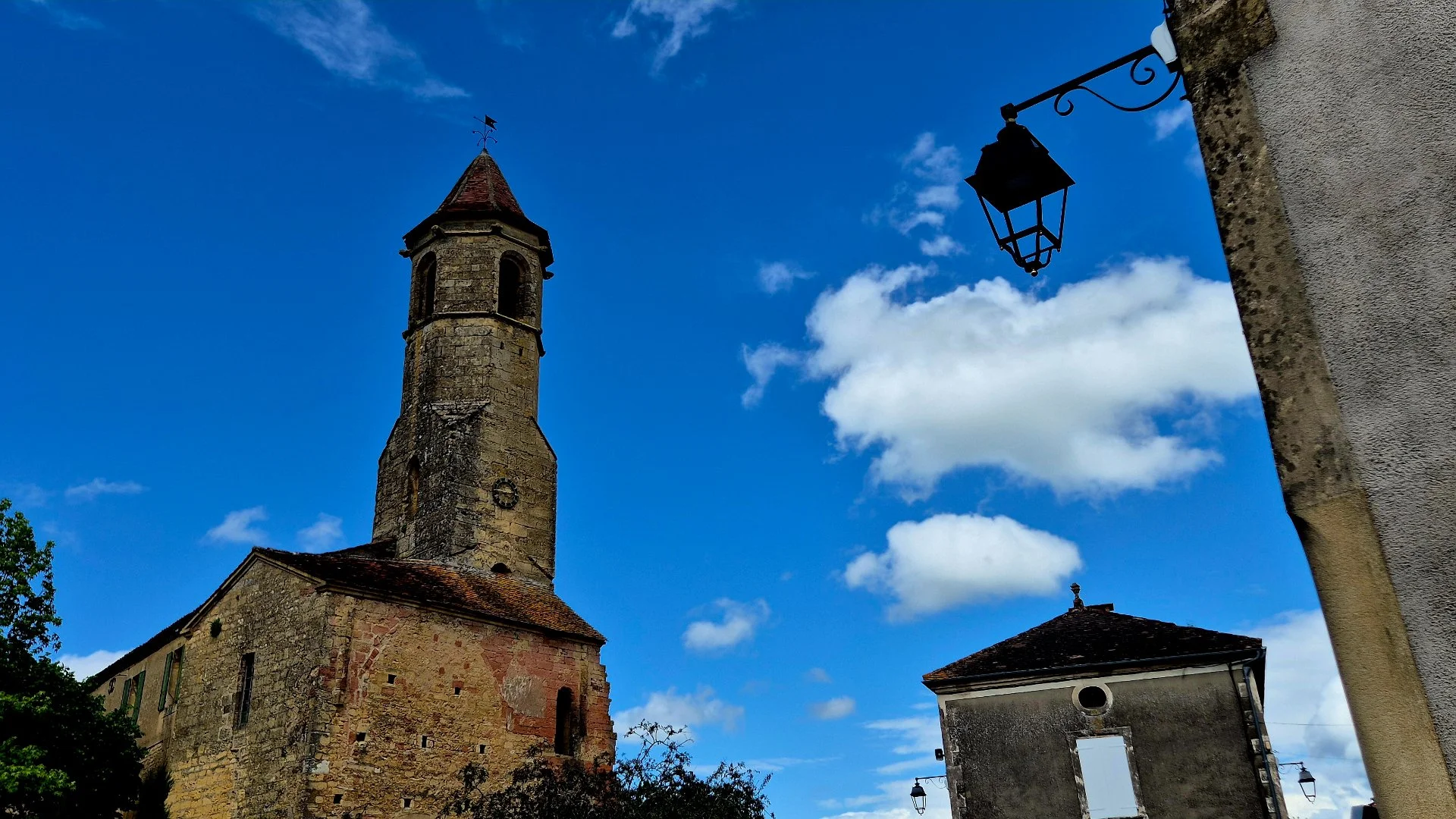
A slender octagonal stone tower rises between the rooftops.
This is not simply a decorative tower belonging to the town hall.
It is the surviving bell tower of the former Dominican convent — the Couvent des Frères Prêcheurs.
The Dominicans established themselves in Belvès in the early 14th century.
Their convent created an important religious enclosure within the developing medieval town, with its own church and buildings.
Much of that complex has disappeared.
The bell tower survived.
Today, it stands almost detached from the story of the convent that created it.
Visitors pass the mairie, look up at the tower and often have no idea that they are looking at a surviving fragment of medieval religious Belvès.
LOOK FOR
The elegant octagonal stone tower beside the mairie.
WHERE
Walk down Rue Manchotte, the main shopping street and turn right to Place de la Croix des Frères.
──────── ◆ ────────
The Tour des Filhols
The Bell of the Consuls
──────── ◆ ────────
Not every bell in medieval Belvès belonged to the Church.
Beside the Maison des Consuls stands the Tour des Filhols, part of the old fortified fabric of the town.
In the 15th century, the tower was adapted as a beffroi — a civic belfry.
Its bell belonged to Belvès.
Known as the Cloche des Consuls, it was the voice of the town rather than the voice of the Church.
The bell hanging here today dates from 1679.
In a medieval town, a civic bell mattered.
It could summon the population, mark important moments and give the consuls of Belvès a voice that carried across the rooftops.
Its presence also adds an intriguing complication to the story of the seven clochers.
The Tour des Filhols is not a church bell tower.
It is the bell tower of the town itself.
LOOK FOR
The small belfry rising above the medieval tower.
WHERE
Beside the Maison des Consuls, now home to the Tourist Office on Place D’Armes, the main square.
──────── ◆ ────────
The Lost Clocher of Saint-Nicolas
The Chapel of the Castrum
──────── ◆ ────────
Walk into the medieval castrum through the main arch on the bottom left hand side of the main square, Place D’Armes. This is Rue Rubigan.
Follow Rue Rubigan.
Then turn into the tiny Impasse Saint-Nicolas. (There is usually a chess table opposite the Impasse during the summer months and on nice days.)
At the end of this quiet lane, the town once looked very different.
Here stood the Chapelle Saint-Nicolas — the chapel of the medieval castrum.
The chapel is documented as early as 1262.
It occupied the fortified heart of Belvès, standing close to the southern ramparts above the steep streets below.
For centuries, Saint-Nicolas formed part of the religious landscape of the castrum.
Then, in 1782, part of the old rampart collapsed.
The chapel was destroyed.
Its presence disappeared from the skyline.
Today there is no church to enter.
No tower to photograph.
No bell to hear.
Only the name Impasse Saint-Nicolas quietly preserves the memory of the chapel that once stood here.
LOOK FOR
The lane itself.
The chapel has disappeared.
WHERE
At the end of Impasse Saint-Nicolas, just off Rue Rubigan.
──────── ◆ ────────
Notre-Dame de Capelou
The Pilgrimage Bell Tower
──────── ◆ ────────
Beyond the medieval centre of Belvès lies another important religious landmark.
Hidden among the trees is Notre-Dame de Capelou, one of the historic pilgrimage sites of the Périgord.
A chapel associated with Sancta Maria de Capella is recorded in the medieval period.
Across the centuries, the sanctuary suffered through war, destruction and rebuilding.
The present chapel dates largely from the 19th century.
Its bell tower still rises above this peaceful religious site.
Capelou stands outside the compact medieval centre, and that raises another intriguing question.
When people spoke of the clochers of Belvès, did they count only those within the old walls?
Or did the identity of Belvès include the bells of its surrounding religious landscape?
No surviving simple list gives us the answer.
LOOK FOR
The bell tower above the pilgrimage chapel.
WHERE
Notre-Dame de Capelou, a short distance west of the historic centre.
──────── ◆ ────────
A Skyline That Has Changed
──────── ◆ ────────
Belvès Was Never One Simple Medieval Town. To understand the seven clochers, you first have to understand Belvès. The town developed along a rocky ridge overlooking the Nauze Valley.
At one end stood the ancient religious centre of Montcuq. At the other stood the fortified castrum. Between them grew the market town.
Later, the Dominican convent created another major religious enclosure.
Belvès was a town of different centres, different authorities and different voices.
Monks.
Parishioners.
Dominicans.
Consuls.
Each left their mark on the town. And each had reason to make themselves heard. Through bells. Churches, Chapels and Bells Now Lost.
The Belvès we see today is not the Belvès of the Middle Ages. Buildings disappeared. Religious communities were dissolved. Churches were altered. Chapels were abandoned or destroyed.
The Chapelle Saint-Nicolas is the clearest example.
Its existence is documented. Its location can still be identified. Yet the building itself has vanished.
Other parts of the religious landscape of Belvès are harder to reconstruct.
Old documents record a town shaped by churches, chapels, religious communities and fortified enclosures.
Not every structure survived long enough to be photographed.
Not every bell tower was described clearly enough to be identified today.
And that is the difficulty with trying to create a simple list of seven.
──────── ◆ ────────
Can You Still See Seven Bell Towers Today?
──────── ◆ ────────
Probably Not
At least, not as seven obvious medieval church towers that can simply be counted from a single viewpoint.
Belvès is still proudly known as la cité aux sept clochers.
The name appears in tourism guides and remains central to the identity of the town.
Yet the surviving historical and heritage sources do not give us a universally accepted numbered list of seven named clochers.
Perhaps the name belongs to a particular moment in the history of Belvès.
A time when more bells punctuated the ridge above the Nauze Valley.
A time when Saint-Nicolas still stood inside the castrum.
When the Dominican church remained beside its bell tower.
When the religious landscape of the town was more complex than the one we see today.
The skyline changed.
The name remained.
──────── ◆ ────────
Follow the Bells Through Belvès.
A Walk Through the Story of the Seven Clochers
──────── ◆ ────────
Begin on Place d'Armes, in the medieval heart of Belvès.
Beside the Maison des Consuls, now the Belvès Tourist office, look up at the Tour des Filhols and its civic belfry, home to the Cloche des Consuls.
From Place d'Armes, enter the castrum and follow Rue Rubigan through the oldest fortified heart of the town.
Turn into the tiny Impasse Saint-Nicolas and walk to the end of the lane.
Stop here.
The Chapelle Saint-Nicolas, the chapel of the medieval castrum, once stood here. Its bell tower has long since disappeared from the skyline.
Return to Rue Rubigan and continue through the old town before making your way to Rue Manchotte, Belvès' main shopping street.
Follow Rue Manchotte towards the mairie. At the bottom of the road is the Chateau de Belvès. Turn right on to Place de la Croix des Frères.
At Place de la Croix des Frères, look up to find the slender octagonal Dominican bell tower rising above the rooftops.
From here, retrace your steps slightly and take Rue du Barris (opposite Rue Manchotte, the main shopping street) and continue west.
Keep walking.
Gradually, the great bell tower of Notre-Dame-de-l'Assomption comes into view, rising above the town as you approach the ancient religious centre of Montcuq.
After visiting the church, stand near its main entrance.
Almost opposite is Rue de l'Aérodrome.
Follow the road away from the medieval town towards Notre-Dame de Capelou. From the church, the walk is approximately 1.3 kilometres and takes around 18 minutes on foot.
At the end of the route, among the trees, the pilgrimage chapel of Capelou and its bell tower await.
Place d'Armes → Tour des Filhols → Rue Rubigan → Impasse Saint-Nicolas → Rue Manchotte → Dominican Bell Tower → Rue du Barris → Notre-Dame-de-l'Assomption → Rue de l'Aérodrome → Notre-Dame de Capelou
Take your time. And remember to look up.
──────── ◆ ────────
──────── ◆ ────────
It is easy to explore Belvès by looking straight ahead.
At the stone houses.
The medieval doors.
The narrow lanes.
The market hall.
But to understand the town of seven bell towers, you need to do something else.
Look up.
Above the rooftops are fragments of a much older Belvès.
A parish church.
A Dominican convent.
A civic belfry.
And in a quiet lane inside the castrum, the memory of a chapel that has completely disappeared.
The seven clochers may no longer be seven towers waiting to be counted.
Perhaps they are something more interesting.
A skyline of bells, history and memory.
Belvès has watched over the Nauze Valley for centuries.
Its bells have belonged to monks, parishioners, Dominicans and consuls.
Some of their towers still rise above the rooftops.
Others have disappeared.
Yet the name has endured.
Belvès — forever la cité aux sept clochers.
──────── ◆ ────────
Plan your visit
──────── ◆ ────────
The bell towers are best discovered as part of a walk through the village.
Combine this with:
a visit to the troglodyte caves
time in the main square and market hall
──────── ◆ ────────